Early Deterioration Detection Tool
Know which residents need attention today
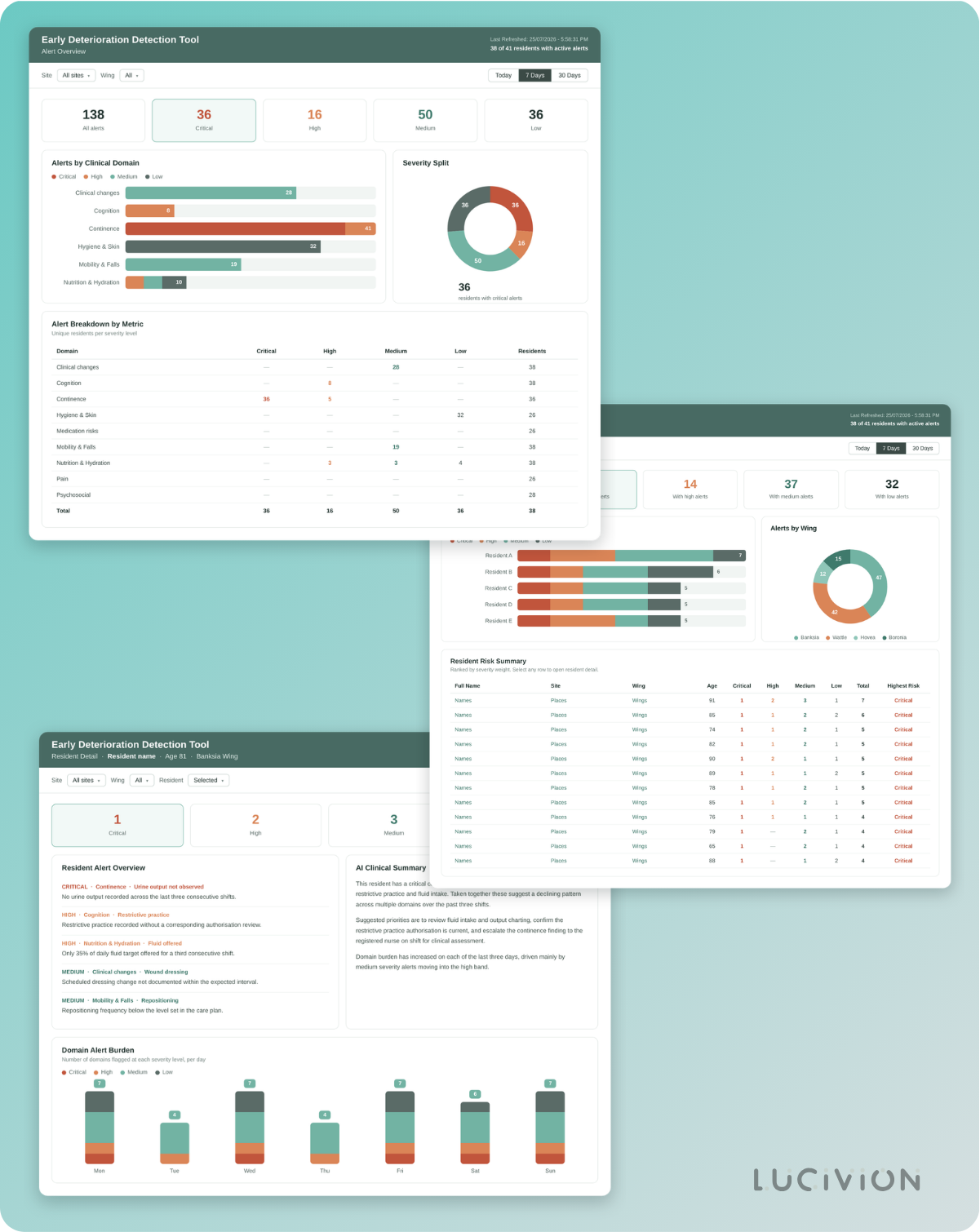
Lucivion's Early Deterioration Detection tool reads the clinical data your team already records and applies research-based thresholds to it, flagging the residents showing early signs of deterioration. Alerts are grouped by clinical domain and ranked by severity, so clinical staff can see where to focus each day without reviewing every chart.
"We're very happy to see leading edge research turned into reality. The system allows us to automatically identify clinical deterioration early, monitor trends, and continue to ensure the highest quality of care for our residents."
-Mark Sheldon-Stemm, CEO, ValleyView Aged Care
on the Lucivion Early Deterioration Detection tool

How does it work?
Extracts data from your existing care and medication management systems, and uses AI to clean, classify and structure it.
Applies detection thresholds across eight clinical domains and 22 metrics, then ranks residents by severity weight, from Critical down to Low.
Presents alerts in three dashboards: an overview by domain, a ranked resident summary for shift handover, and a resident detail view with a 7-day trend and AI summary.
Why this hasn't been possible before
Deterioration signals are rarely sitting in a tidy field waiting to be counted. They are spread across progress notes, charts and medication records, written differently by different staff across different shifts. Our AI pre-processing layer enables us to convert existing documentation into a consistent set of data for each resident. Only then can a threshold be applied reliably, across a whole service, every day.
Research-based, and built around your service
Our detection thresholds are based on published clinical research, including Bail, K. et al. (2026), A Digital Alert Feedback System (Aged Care Electronic Dashboard Information Tool, ACED-IT) to Enhance Quality Nursing Care: Participatory Action Research, Journal of Clinical Nursing, 35(1), 397 to 423.
We've built on that foundation in practice. Thresholds, domains and severity weightings are tuned to your cohort, your documentation practices and your clinical priorities, so alerts reflect what matters in your service rather than a fixed rule set. Every alert traces back to the data that triggered it and the threshold it crossed, and the full logic is documented for your team during onboarding.
Benefits
Earlier intervention when a resident's condition starts to change, supporting proactive care
Faster handover using a ranked resident list and alert detail table built for shift change
Trend visibility across domains, metrics, facilities and residents, so you can see whether risk is rising or resolving
Signals you would otherwise miss, as AI pre-processing surfaces detail recorded in unstructured documentation that manual review and standard reporting do not capture
No additional workload for clinical staff, as the tool uses documentation your team already completes
Evidence for clinical governance, demonstrating an active system for identifying and escalating deterioration risk
Configured to your service, with thresholds adjusted during onboarding and tuned further once your team is using it
Supports Standards 2.4 and 5.1